
Two Wolves in the Digital Forest: Dreamweaving Toward 2040


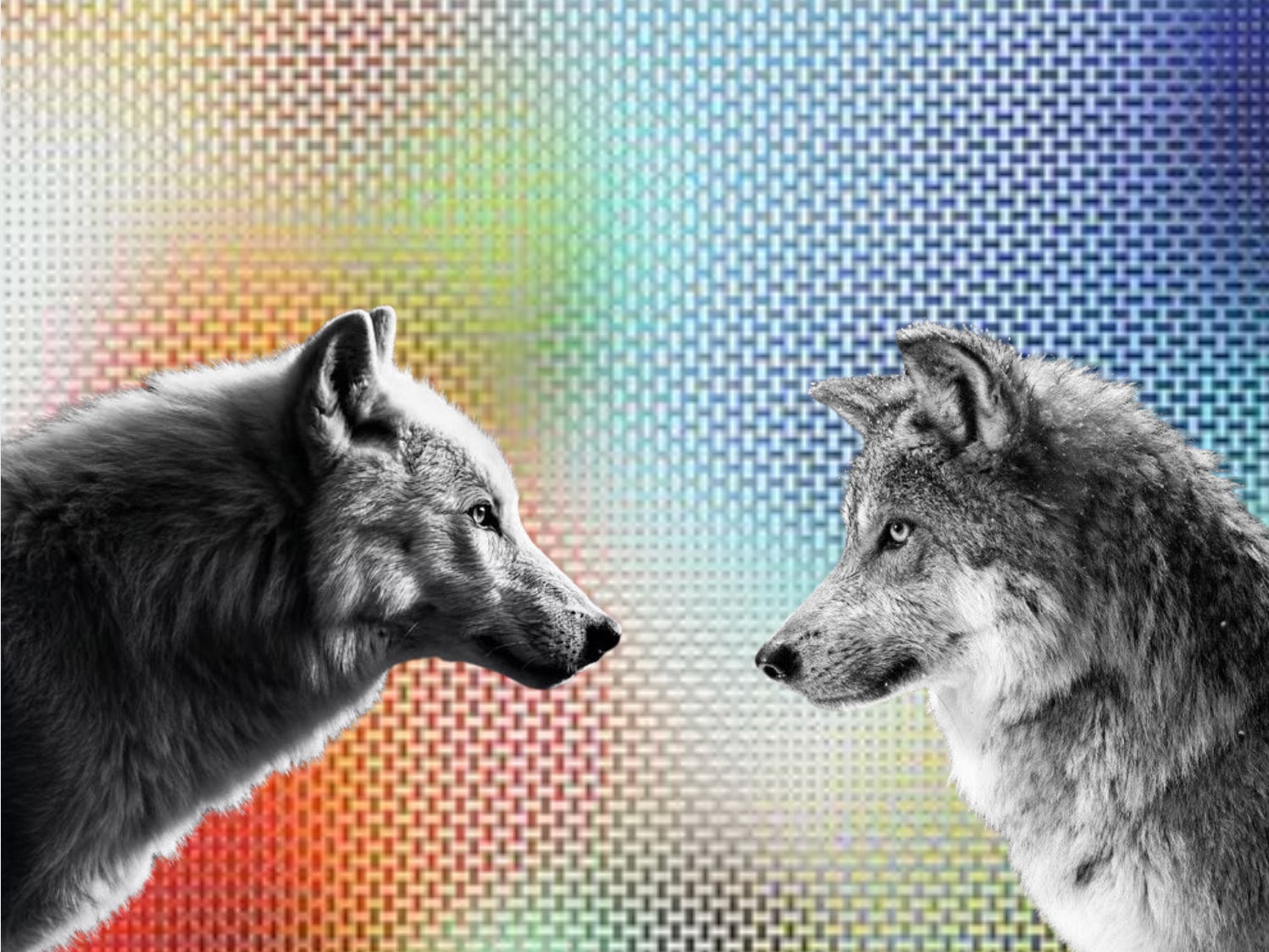
Some nights, I lie awake thinking about the children learning to cope through screens. Their big emotions cast in blue light, their longings archived by algorithms. They are growing up inside a forest they did not plant, one wired with whispers, pings, and mirrors that do not always tell the truth. This is what I call the digital forest. It is the terrain our young people walk through every day, sacred and treacherous at once. A place where memory meets machinery, where creation and consumption blur.
Inside each of us live two wolves, and in this era, they roam that same digital forest. Technology is not the wolf, it is the terrain we walk, the landscape that mirrors back our hunger, our loneliness, our longing to be seen.
In this forest, the Shadow Wolf feeds on distraction, comparison, speed, and surveillance.It teaches us to mistake performance for presence, and metrics for meaning. It thrives on the endless scroll — on the illusion of connection that leaves us emptier the longer we stay.
The Medicine Wolf, on the other hand, moves differently. It listens between the noise. It creates with conscience and care. It reminds us that not all intelligence is artificial — that the oldest form of knowing is still the one that lives in our bodies, our breath, our relationships.
Every scroll, every post, every design choice is a feeding. One wolf grows stronger. The other, quieter. And the forest, our shared digital ecosystem becomes what we feed.
the world we are building toward
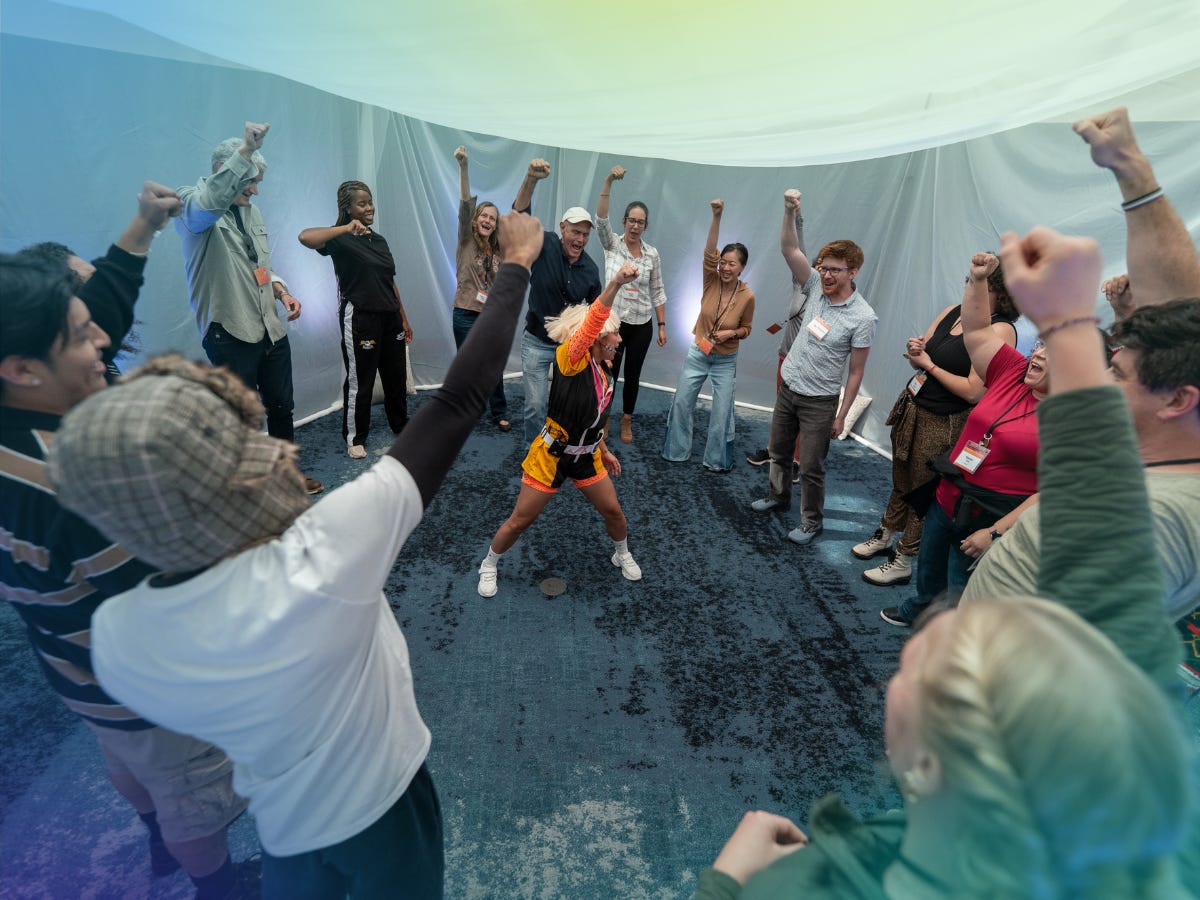
This September, I was invited, alongside thirty-five other strangers, to a small mountain town called Lone Rock, Colorado — a gathering hosted by The Rithm Project to explore one question: How do we reclaim and evolve human connection in the age of AI?
Asked a different way: which wolf are we feeding?
We left our professional identities, titles, and roles at the door and sat side by side, engineers beside doctors, educators beside artists, youth beside elders — not to solve, but to see. The conversations weren’t about code or competition; they were about care and the world we wanted to cultivate.
On the second day, we were guided through a deeply reflective and dynamic experience called Immersive Futures — an interactive window into what life and technology could look like fifteen years from now, in 2040.
It stirred both fear and possibility, awakening something in each of us as we stood at the edge of humanity’s next evolution. We asked: What of these futures do we want to call toward us — and what must we avoid? It was a question I couldn’t shake.
2040: a world of kinship
It was 3AM on that second night and I couldn’t sleep. My mind kept circling back to what 2040 might actually feel like, not the future that was sleek and optimized, but something quieter and more human. A world that still smells like rain on soil. A world where laughter echoes down real hallways, where no one’s performing for a screen.
Out of that sleepless night, something began to take shape. It started as a free write, then formed into this piece I now call 2040: A World of Kinship.
In 2040, the streets themselves are prayers. Every name you pass belongs to a native ancestor, a mountain, a river, a medicine plant. Walking down a block is never just transit—it is ceremony. Children can tell you each meaning because schools no longer prepare them for tests; they prepare them for life in relationship. Education here is not extraction—it is preparation for travel between villages, cultures, and worlds. Before visiting another place, students enter virtual immersions, learning the cadence of the local language, the ways of greeting elders, the gestures of respect for women, men, and children. They are taught how to listen to plants, how to ask permission before gathering, how to understand that they are never alone.
Every dawn begins with remembrance. Communities pause to honor those who should still be with us. Birthdays of those lost to genocide are not forgotten—they are marked with trees planted, songs sung, and stories carried into the present. The names of Black lives stripped from existence are spoken daily, not as numbers, but as ancestors whose sacred medicine the world aches for. In grieving them, we grieve ourselves. And we are taught not only how to mourn, but how to atone. We learn how to repair, how to return what was taken, how to rebuild trust after violence.
Land Back is not a slogan—it is reality. In Hawai‘i, there are no waiting lists, no displaced lineages. Families are back on their ancestral lands, stewarding what was always theirs. Across continents, Indigenous nations guide the care of their territories, while non-natives commit to lifelong education on how to be good guests. To live on land that is not yours means returning again and again to humility: to listen before speaking, to give before taking, to know you are accountable to the earth you walk.
Technology has been transformed from a tool of consumption to an instrument of kinship. Artificial intelligence has become kinship intelligence, deeply informed by the original AI, Ancestral Intelligence—guiding communities in forgiveness, reminding us when silence is needed, when ceremony is required, when it is time to gather and repair. Devices are designed to strengthen life force. Glasses glow gently to signal openness to connection, pulsing with the length of time someone can offer. Jewelry carries safety: a nose ring or device that can be activated by a light squeeze sends your location and level of urgency to trusted kin; earrings whisper words of worth when bullying cuts deep. If harm arises, a wolf’s growl or dog’s bark echoes—not to instill fear, but to signal the village: it is time to stop, to sit, to breathe. The whole community joins in meditation, turning attention to the birds until nervous systems are soothed.
In health and healing, no single system dominates. Western, Eastern, and Indigenous medicine work side by side, weaving their gifts into one fabric of care. Seers, spiritual guides, acupuncturists, herbalists, midwives, surgeons, and physicians collaborate, holistically tracing the root of illness and offering layered pathways for healing. Prevention is the highest form of medicine. Every doctor is also a farmer, trained in agroforestry, tending soil as part of their practice, for they know that the health of the land and the health of the body are inseparable. Trauma-informed and land-based healing is as much for the healers themselves as for those they serve—because no one can tend another without also tending their own spirit.
Schools are not only for children but intergenerational—grandparents learning alongside toddlers, parents and teenagers apprenticing together. Listening is a skill practiced across all ages: listening between humans, and listening between beings—plants, rivers, animals, wind. Education honors transitions and thresholds, recognizing rites of passage not as private struggles but as communal celebrations. Progress is never divorced from play. Play is the pedagogy, the pulse of learning, the proof of thriving.
Here, justice is embodied in daily life. Children are raised as guardians, not consumers. Adults are measured by their capacity to repair, not to dominate. Elders are honored as the carriers of nuance, teaching us the delicate art of how to speak and when to be silent. We are reminded that technology, land, memory, medicine, and body are all kin.
This is 2040: a world where grief is honored, repair is practiced, and every step is in relationship. Where land, people, and technology are braided together. Where Western, Eastern, and Indigenous medicines walk hand in hand. Where school is for all, where play guides growth, and where to live is to be in kinship—and to be in kinship is to know we are never alone.
This, to me, is the world we build when we keep feeding the Medicine Wolf.
an invitation to dream.
The next morning, I shared this piece with our circle in Colorado. As I spoke, I realized this wasn’t an act of prediction.
It was a prayer.
In a world that so often reacts to the latest technological tremor, this vision reminded me of our collective agency — the ancestral wisdom of dreaming as a form of design.
I offer it to you here in that same spirit.
Listen — or read — not for answers, but for openings. Notice which word or image stirs something in you. Let it spark your own vision for 2040 — what might it look like, sound like, feel like?
Then weave your dream with mine, and with those you love. Let’s walk this new terrain together — tending the remembering fire, and feeding the future worthy of both our ancestors and our children.
About the author
Glenda Macatangay, MSW, is a Hilot Binabaylan, healing arts educator, cultural strategist, and community organizer dedicated to advancing mental health, ancestral healing, and collective well-being through the power of arts, culture, and care. As the founder of My Healing Language, she creates transformative programs that bring ancestral wisdom and holistic healing practices into schools, community spaces, and family systems. Her work—including the Heart Warrior Training Program, The Ego Check Podcast, LIFEFORCE Embodiment Collective, Memory Palace-Survivor Movement, and Comes In Waves Grief Circles—centers those most impacted by trauma, disconnection, and generational silence. Glenda’s approach is relational, intuitive, and deeply rooted in her identity as a first-generation Filipina-American and daughter of immigrants from Batangas, Philippines.
A former psychotherapist and social worker with over two decades of experience, Glenda is known for bridging ancestral memory with systems change. She is the co-founder of Youth Wellness Movement (a program of Community Responsive Education), Art of Becoming, and Born & Raised Stories, and leads equity and organizational wellness consulting through Paz y Luz Consulting. She is also a mother of four intuitive children and a devoted storyteller, committed to building pathways of healing across generations. Salt in Her Lungs: A Memoir of Trauma, Healing, and the Wisdom of the Waters is her first book. It is a courageous offering that weaves personal narrative, spiritual insight, and cultural remembrance into a guide for anyone learning to breathe again after silence.
She is the founder of My Healing Language and creator of 2040: A World of Kinship and Two Wolves in the Digital Forest framework that bridges ancestral intelligence, ethics, and emotional resilience to guide youth and adults in reclaiming connection in the digital age. Help us imagine the world we owe our descendants.
 | A guest post by
|
Endless gratitude for creating and sharing this beautiful vision. I have been longing to read this vision again, to keep it close and to share it with others I know will love it as well. I was forever moved and changed when you read this at Lone Rock, Glenda!
Thank you for sharing this beautiful vision