
“It’s there when people aren’t”
What LGBTQ+ young people are finding in AI, and where they draw the line

Written in collaboration with Rithm Youth Fellow, Hannah Groos.
The first place I went looking for answers about my sexuality wasn’t from another person, but instead a search bar. I was twelve, growing up in a small town outside of Des Moines, Iowa.
I typed questions into Safari late at night that I would never talk about out loud and took “Am I Gay” quizzes over and over again. I learned the word bisexual from those quizzes. Later, I followed female and nonbinary athletes on Instagram, the kind who were masc, athletic, queer, and asked myself the question every queer girl I know has asked at some point: do I want to be her, or do I want to date her?
It took me a long time to realize the answer could be both. By senior year I’d gotten comfortable enough to seek out sapphic stories on purpose, on Wattpad, on streaming, in the library app, but only where no one could see what I was checking out. While none of it felt exactly like community, it did feel like a mirror that helped me see parts of myself no other space in my real life helped me recognize.
But the internet I grew up with, for all its late-night privacy, was still full of other real humans. The romances I found on Wattpad were written by a fellow queer woman. The strangers I followed on Instagram were real. I watched my TV shows alone, but I knew thousands of other girls were watching them too.
AI is something different. It’s private, extremely personalized, instant, and willing to give you an answer before you’ve even finished forming your question.
To be clear, I’m not an AI skeptic. I use it daily and I’m going into a career where I hope to be in the room building it. But when I prepare for job interviews and use AI to brainstorm strengths, ChatGPT gives me back over-feminine answers. They’re too gentle, soft, and focused on the parts of my identity I don’t actually lead with. While this is a small thing, it’s also a reminder that these systems have a model of “young woman” that they’re quietly trying to pull me toward. Luckily, as someone who studies responsible AI, I notice this. However, I think a lot about what it could do to a confused 14-year-old girl from my hometown who doesn’t notice.
I’ve been sitting with this wondering: how are other queer youth today experiencing this new wave of AI? Not the internet queer millennials, and older Gen-Zers grew up with, the internet that was full of forums and chatrooms where you stumbled into community, but the more individual, automatic, and providing more answers than questions technology youth today are facing.
As a Youth Fellow for The Rithm Project, I was part of the team who surveyed 2,400 young people about how they’re using AI. A few findings stopped me.
LGBTQ+ youth were 2.5x as likely to be conscious abstainers — choosing not to use AI at all for values-based reasons (34% compared to 13.5% of non-LGBTQ+ youth).
They reported higher rates of anxiety, of feeling like a burden, of feeling like there’s no one to turn to than their non-LGBTQ+ peers.
And across nearly every high-risk AI behavior we measured, they had the lowest rates: less dependence, less human displacement, less emotional reliance on AI tools. The one exception was that they were more likely to hide their AI use from others.
We saw the numbers. But we couldn’t see the stories underneath them. Then we found Will Liem, a human-centered AI researcher who runs a Youth Advisory Council of 20-30 LGBTQ+ teens on a private Discord server, studying how they navigate questions of sexual orientation and gender identity with and without AI. We asked him to help us make sense of what we were seeing. Here’s that conversation.
*This interview has been edited for length and clarity.
The Rithm Project’s latest research found that LGBTQ+ youth were more likely to not be using AI at all — and specifically, that they were choosing not to for values-based reasons. Why do you think that is?
This tracks with what I hear from my participants. When I first started this project, my plan was to co-design a custom AI tool with LGBTQ+ teens — curate the datasets together, train the model together, build the interface together. It would be co-developed with the youth. And initially, a lot of our participants were interested. They were like, “Wow, this is cool, we get to make our own custom tool.” But over the months in 2025, especially with news reports around environmental concerns, labor exploitation, and the ethics of training data, a lot of our participants started to resist. It almost felt like a counter-movement, a counter-culture toward the dominant presence of “AI everything.”
I think it makes a lot of sense when you consider who these young people are. Queer teens, especially those who are also navigating intersecting identities such as race, class, different religions — they often develop critical structural literacy earlier than their peers. When the systems around you have been hostile to your existence and multiple identities, you get really good at asking: who benefits from this, and who gets hurt? And that analysis doesn’t stay contained to the things that have directly harmed you. It spills over. So when they look at AI, they’re applying the same moral framework they use to survive everything else.
It feels like there’s a really important values-based interrogation happening — if I’m existing in a world that is already by design not built to support me, that criticality transfers to everything around me.
For sure. I had one participant who intentionally doesn’t use AI because they don’t want to support the death of human creativity. They have visions and aspirations to become an artist, a creative, and they were saying things like, “AI is the antithesis of human creation.” For them, because they’re in this creative realm, they’re embracing imperfection, embracing mess. And AI is the opposite of that — it loves to aggregate, it loves to refine and optimize. For this teen, what was important was really sticking hard to their values.
Even though LGBTQ+ youth aren’t using AI as much, the ones who do report have higher rates of hiding their AI use. They also report higher rates of anxiety, feeling like a burden, and feeling like there’s no one to turn to. Based on your research, what story is underneath this?
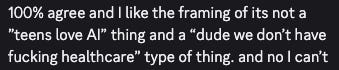
As part of my research process, I engage our Youth Advisory Council as co-analysts. I share emergent findings with them to get their thoughts. One of the findings I shared was that teens turn to AI because other options — a friend, a therapist, a parent — feel unavailable. It’s not because AI is their first choice. And one of my favorite quotes in response was: “I like the framing of it’s not a ‘teens love AI’ thing and a ‘dude, we don’t have fucking healthcare’ type of thing.”
The assumptions people make about why queer teens turn to AI — conservative communities, not being out, no one safe to ask — those are true. But the texture of it is more specific than that. I have two examples from my interviews.
One participant identifies as a bisexual male and is navigating what it means to be bi and Muslim at the same time. He went through Reddit forums because he didn’t feel comfortable asking about it with his in-person community. He knew there would be backlash. And Reddit was hostile — very negative and harsh things about what it means to be queer and Muslim. So he went to ChatGPT to ask the same questions, and ChatGPT gave him basically the same answers as people on Reddit. But ChatGPT delivered it with more gentleness, more “care.” And somehow that made it possible for him to sit with the reality rather than fight it. Same information, but a different landing. That tells me something important, that maybe sometimes teens aren’t looking for a different answer. They’re looking for gentler guidance to accept a difficult reality.
It’s not the message, it’s the messenger.
Right. And sometimes people are so focused on the outputs of AI — the hallucinations, the potential biases — but sometimes it’s how you say it and how you deliver it that can help teens process difficult realities a little more safely than they would from sources that might not offer a nuanced take, or offer an affirming tone to help come to terms with things
You had a second story.
This one I thought was very interesting. This particular teen described her social environment as incredibly supportive. I think she mentioned that at least a third of her school identifies as openly queer. She lives in a very progressive area. Really tight, robust support network. And she’d just entered her first sapphic relationship and wanted to learn how to be a better partner to her girlfriend. She went to her friends and said, I feel like there’s some tension between my girlfriend and me, but I don’t exactly know how I can be a better partner — this is my first girlfriend, my first sapphic relationship. And all of her friends were basically saying, “bestie, you can’t do anything wrong. You’re totally fine. You’re doing everything right.”
While that was nice and affirming, she wanted some sort of constructive feedback. So she ended up going to ChatGPT, because she knew it could at least offer the type of support that she needed.
I feel like oftentimes what we assume in the popular discourse is that there’s an absence in a young person’s life. But sometimes it’s not the absence of a person — it’s a misalignment in the type of support they need. We need to be more specific about what we mean by “support.” Sometimes it means gentleness. Other times it means pushing back. And the mismatch between what you need versus what you get can sometimes be just as isolating as having no support at all.
So how do we think about bias in this context? Because LGBTQ+ youth are navigating it from every direction — in their real lives, in religion, in their communities, and in the technology itself.
This is one of the most interesting and contradictory insights so far. When we initially ask teens about their concerns about AI, obviously there are the ethical concerns — environmental impacts, data exploitation, privacy. But they’re also concerned about biased AI tools, because they’re aware it’s trained on largely cisnormative, heteronormative data. They know what sorts of potential harms might arise if a queer teen uses it.
But here’s the interesting part: There are certain moments when some of my participants go to AI specifically because it offers an “unbiased” perspective. Go back to that teen in the sapphic relationship. She said something like, “I wanted my friend’s point of view, and then an unbiased point of view.” She went to AI, which she recognizes as biased, in order to get around a different kind of bias.
So I think we need to be much more specific about what biases we’re trying to avoid. What teens and most media coverage are identifying is what I’d call epistemic bias — these tools are trained on large datasets that aren’t completely representative of all the different users, which could generate outputs that don’t match a user’s needs, or worse, harm them. But what we’re also seeing is relational bias — the people in their communities carry their own biases and prejudices that get in the way of the support they need and push them toward AI. Her friends’ unconditional support was a form of relational bias. These friends didn’t want to cause harm; they wanted to be unconditionally supportive, but that wasn’t what she needed.
Within the context of my study, teens found epistemic bias to be easier to correct for — as teens can work with more pointed prompting strategies or just avoid the tool altogether. Relational bias is harder. How are you going to change someone’s preconceived notions?
There’s a long history of queer communities finding each other through technology — AOL chat rooms, Tumblr, Discord. What feels different about this wave?
What’s the same is the underlying appetite for community and examples of queer joy. Queer teens have always gone online to find proof that people like them exist. Whether it’s AOL, MSN chat rooms, Tumblr, Instagram, TikTok, Discord — in every new wave of internet technology, queer youth somehow find a path to each other.
The biggest difference now is directionality. Social media, books, forums — they’re all about stumbling into a community and witnessing someone else’s life. You see content creators navigating a gender transition, or binding practices on YouTube. The majority of youth I work with report social media as one of their most important resources for navigating questions around identity, because they get to feel seen and represented. Especially for our trans folks, they talk about feeling like they’re not the only one experiencing the feelings they have.
AI inverts all of that. It’s completely one-on-one. It responds to you specifically.
With something like sexual orientation and gender identity, there’s so many different flavors, colors, shapes, and expressions of what it means to be queer. I remember when I was on Tumblr first discovering my sexuality, there were a hundred different ways I was exposed to what it could mean to be queer — different forms of how you express love, different ways of presenting yourself. And you just sit with that imagination, that creativity, and exposure to all these different possibilities of what you could be. AI has this tendency to converge toward an answer. And especially for teens who are still in the process of developing that identity complexity, they might feel pressured to get that question resolved.
Your participants talk about AI being useful up to a point. Where does it run out?
After a certain point, identity exploration requires human witnessing — someone to know you, someone who can contextualize you in your environment. I have a participant who talked to ChatGPT about where they might fit on the aromantic, asexual spectrum. They’d used online quizzes, but the quizzes assigned a label, and that felt restrictive. They liked ChatGPT better because they could actually have a discussion, and ChatGPT provided productive reflection questions they wouldn’t have thought to ask themselves.
But then they took those insights and talked to their partner about how different labels might fit them. And they used those labels to introduce themselves in different social situations with friends over time. Their partner and friends know their history, their preferences — they can see these changes over time. AI can’t. AI can only know as much as what you give it.
One quote I love is a participant talking about how they’d miss “the personality of the internet” if they relied primarily on AI for these questions. What they meant was the looks, aesthetics, colors, designs, and images of diverse queer people and bodies on an LGBTQ+ organization’s website. These are subtle cues that signal “you belong here” or “there are queer people just like you.” I call this ambient affirmation — it’s almost like a backdrop that feels inviting and affirming, especially to those who might not get that from their communities. AI can’t make you feel like you’re part of something bigger, because it’s just you and a tool.
What would you hope adult allies and loved ones take away from all of this?
From the group of participants I have, not one wished for an app, tool, or piece of technology. Every single one wished for a person they could trust and feel safe with.
The conversation about AI chatbot safety for queer youth is important. But we need to ask ourselves what to do about the conditions that make AI feel necessary in the first place. The teens I work with aren’t just asking for better algorithms. They’re asking for parents who use their chosen names. Religious communities that don’t threaten them. Friends who can listen intently. In-person spaces they can actually go to.
One of my favorite authors is bell hooks, and she wrote that love is not just a feeling, but a practice. It’s an active, intentional choice to see someone fully, to tell them hard truths, and to stay present when things get complicated. When I look across my data, I feel like that’s the through line underneath all of it — this desire for love, care, to be seen and witnessed. And there’s a shortage of that kind of love. The parent who goes quiet when their kid comes out. The friend who affirms everything because they don’t want to have a difficult conversation.
AI fills that gap not because it’s good at love, but because it’s there when people aren’t. And the teens know the difference. They know AI can never replace humans. But they still turn to it because they need that type of support when other people can’t provide it.
So if I could give one provocation for all adult allies and loved ones: ask yourself, am I the kind of person a young person in my life could come to for support? And if not, what would it take to become that person? Because research is telling us very clearly that teens who have even one person like that in their lives navigate everything differently. Not perfectly. But very differently.
About Hannah Groos
Hannah is a recent Duke University graduate (class of 2026!) studying Computer Science and Psychology. An Iowa-native, she’s passionate about designing AI that promotes flourishing, agency, and reflection. She’s built AI features for youth wellbeing platforms, researched cognitive liberty in Duke’s Cognitive Futures Lab, built AI for Booz Allen, and created programs to help school leaders navigate AI responsibly. As a Robertson Scholar, Coca-Cola Scholar, and former Iowa State Board of Education member, Hannah brings systems thinking, technical skills, and lived experience to shaping responsible technology. Outside of work, Hannah teaches cycling and yoga, and loves weekend bike trips, hiking, and spontaneous adventures with her friends.
About Will Liem
Will Liem is a human-centered AI researcher and incoming Postdoctoral Researcher at Northwestern University’s Teen Health Lab. His work focuses on how LGBTQ+ teens navigate questions of sexual orientation and gender identity through technology, and what the boundaries of AI-mediated support reveal about the relational conditions young people actually need. He engages youth as co-analysts in his research, believing the people closest to the experience should shape how it’s studied.
Will’s LinkedIn: https://www.linkedin.com/in/wllmliem/
Teen Health Lab Socials: https://www.instagram.com/teenhealthlab/
Google Scholar: https://scholar.google.com/citations?user=JDQRbJsAAAAJ&hl=en
This is really interesting and tracks with my trans teen. Actually frontier AI being so overly "woke" helped me come to terms as a parent with my kids transition and become more supportive in the right ways with the right level of distance and conversation. Yet they and their LGBTQ+ pals at school are very much non users. Ironically though they love platform capitalism's social media forums, from tiktok to insta, I am guessing because it's a less isolating experience and drives a valuable global network. Maybe also a GenZ thing. I wonder whether it will be different for Gen-A when they are teens.